Crossover-Waist Flare Leggings: Fit Balance From Waist to Hem
- Share
- publisher
- HUCAI
- Issue Time
- Oct 14,2026
Summary
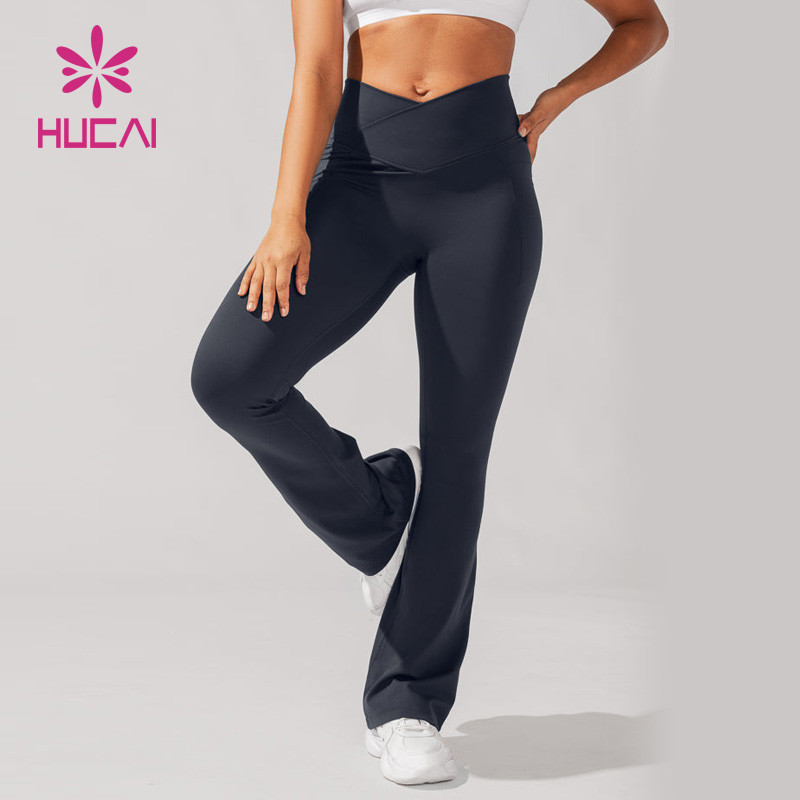
Crossover waist and flare are converging in one silhouette: a crossed front waistband sculpts the midsection while the leg stays close to the knee before opening into a sweep below it. DOYOUEVEN's Aura flared leggings use a mid-rise cross-over sculpt waistband in 78% polyamide and 22% spandex; Splits59 runs the Raquel Crossover Supplex Flare as a new arrival. This guide covers how HUCAI Gymwear develops the style as one proportion system, from crossing panels to hem.
Crossover-Waist Flare Leggings: Fit Balance From Waist to Hem
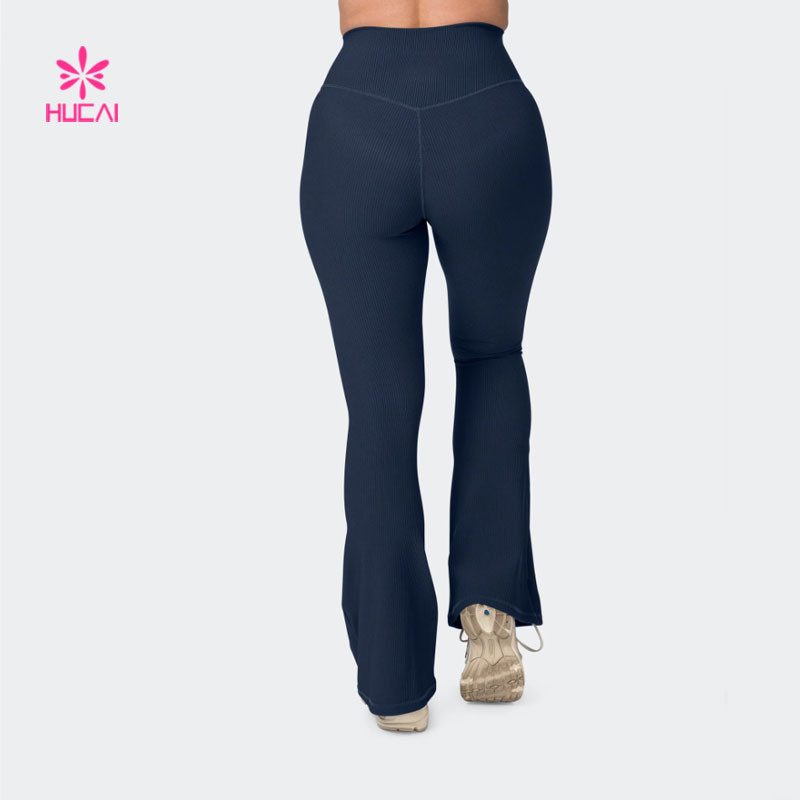
Crossover-waist flare leggings are the clearest example of two trends converging in one silhouette: a crossed front waistband that sculpts through the midsection, and a leg that stays close to the knee before opening into a sweep below it. HUCAI Gymwear, engineered by HUCAI Sportswear, develops this style for American and Canadian brands that want the proportion story without the fit complaints that usually follow it. The difficult part is not the hem width. It is keeping the two crossing panels balanced, holding waistband recovery under the extra weight of a wider hem, and fixing the knee point so the flare reads as a deliberate line instead of a stretched calf. This guide works through the fit balance from waist to hem.
DOYOUEVEN's Aura flared leggings are listed as new and are built around a mid-rise cross-over sculpt waistband in 78% polyamide and 22% spandex, combining an invisible scrunch with a flare leg. Splits59 is running its Raquel Crossover Supplex Flare as a current official new arrival, with a V-shaped crossover waistband and a 4-way stretch Supplex. Both references are selling the same idea from opposite ends: the waistband carries the sculpting claim while the leg below the knee carries the visual length. Consumer discussion stays on the look, but the commercial risk sits where those two halves have to agree.
Develop a crossover-waist flare legging as one proportion system, not three separate specs. Fix the crossing panel lengths and the crossover apex in the pattern, approve waistband recovery on the finished garment with the hem already attached, and set the flare start as a measured distance below the knee for each inseam. With a flexible MOQ from 100 pcs per style and color, HUCAI Gymwear returns a development sample in 7–10 working days.
- 1. Where a crossover waistband actually crosses
- 2. Waistband recovery under the weight of a wider hem
- 3. The knee point decides whether the flare reads as a line
- 4. Hem sweep, inseam length and the drop question
- 5. Holding one waist-to-hem proportion across a capsule
- 6. FAQ for American sourcing and product teams
1. Where a crossover waistband actually crosses
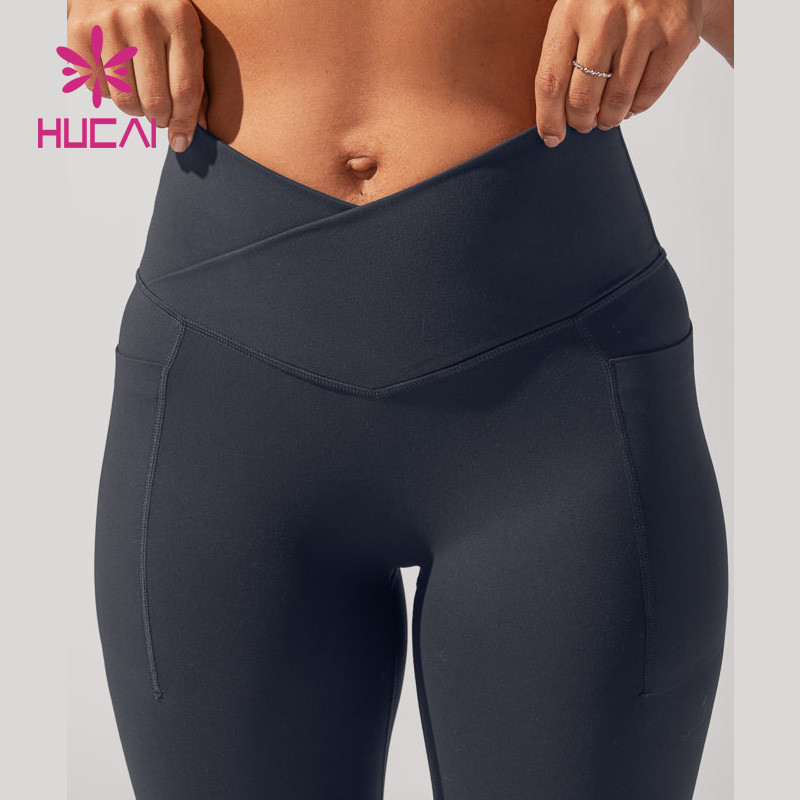
Source and fact. Two current references define the crossover brief from different directions. DOYOUEVEN's Aura flared leggings are presented as new with a mid-rise cross-over sculpt waistband in a 78% polyamide and 22% spandex knit. Splits59 lists the Raquel Crossover Supplex Flare as a new arrival with a V-shaped crossover waistband in a 4-way stretch Supplex. Neither brand publishes the crossing point as a measurement.
Observation. The crossover has moved from a decorative wrap detail to a structural panel that carries the sculpting claim, and the two brands deliberately describe it in different words, one calling it a sculpt waistband and the other a V-shaped crossover. What the market is buying is the flattening effect across the front body, not the wrap itself.
Interpretation. A crossover front is two panels cut on opposite side-grain directions and sewn into a V. If the left and right panel lengths, or the tensions across the overlap, differ even slightly, the crossing point drifts away from the center front and the waistband reads as pulled to one side. The same overlap also changes where compression sits above and below the navel, so the apex height is a fit decision rather than a styling decision, and it has to be graded with the size range instead of fixed as a single number.
Manufacturing recommendation. Define the crossover apex height and the crossing point offset from the center front as graded, measurable specs on the Tech Pack, then cut, pair and number the two panels per size so a left panel is never joined to the wrong right panel. Close the overlap with a flat 4-needle 6-thread flatlock seam so the crossing stays flat against the body, and verify the offset after wash rather than only on the flat table. Our own crossover development specification treats the waistband as a high rise band with two front panels crossing into a V, and the apex is confirmed on the fit sample before any bulk cutting.
2. Waistband recovery under the weight of a wider hem
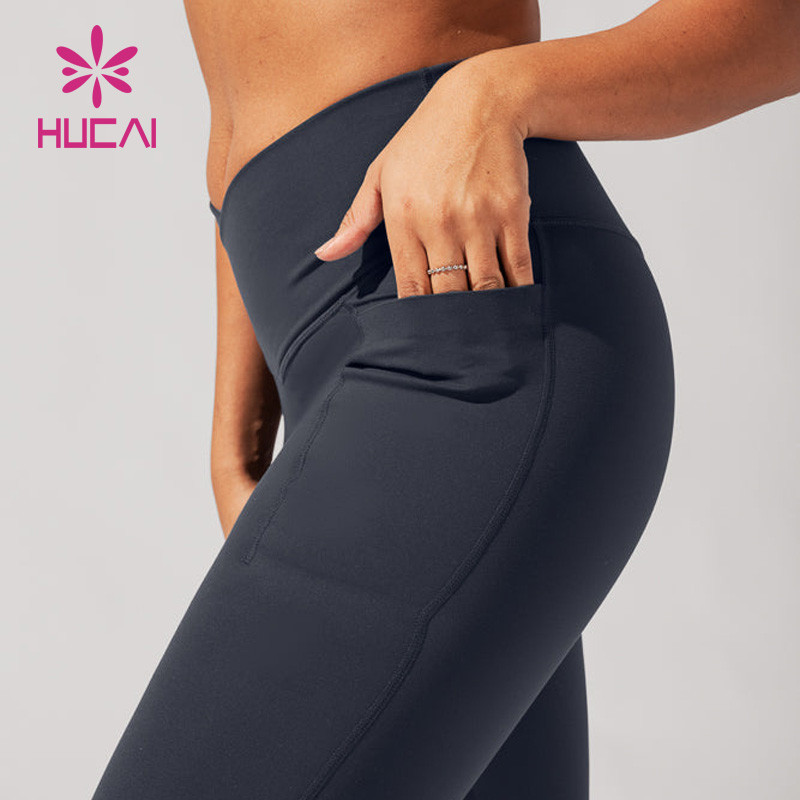
Source and fact. Both references pair a soft, stretch-led waistband with a leg that carries real volume below the knee. Splits59 specifies a 4-way stretch Supplex for the style, and DOYOUEVEN lists a 78% polyamide and 22% spandex knit. The waistband is being asked to feel unrestricted at the same time as the leg gets heavier.
Observation. Buyers are asking for a band that does not dig and a leg that hangs cleanly, which are two requirements that pull in opposite directions. The comfort complaint and the falling-down complaint usually arrive from the same customer in the same review.
Interpretation. A flare hem carries more fabric mass than a skinny leg, and that mass hangs from the waistband. What keeps the garment in place is band modulus and elastic recovery, not the height of the rise or the width of the overlap. A band that passes a flat-table check can still roll over and slide down once the full hem weight is attached, and the failure normally appears in the first two weeks of wear, well after the customer has formed an opinion about the fit.
Manufacturing recommendation. Write band modulus, band height and after-wash waistband height into the purchase order, and test recovery on the assembled garment at the largest size, because the same band carries a different load at the top of the size range. Where the leg is cut heavier, increase the band's recovery rather than simply tightening it, and confirm the whole set of numbers under AQL 2.5 inspection before shipment. That is the point where a factory either protects the brand from returns or quietly hands it a two-week problem.
3. The knee point decides whether the flare reads as a line
Source and fact. Both references describe the flare as a feature and neither publishes a knee point or an inseam. DOYOUEVEN positions the style on a mid-rise waistband, and Splits59 positions its version on a V-shaped crossover waistband with 4-way stretch. The visible geometry that produces the effect is left unspecified.
Observation. A flare is a proportion device rather than a fit device, and shoppers respond to the elongation it creates rather than to the measurement that produces it. That is why the same product photograph sells a range of body heights at once, and why the knee point is the easiest thing for a brand to overlook when it briefs a factory from an image.
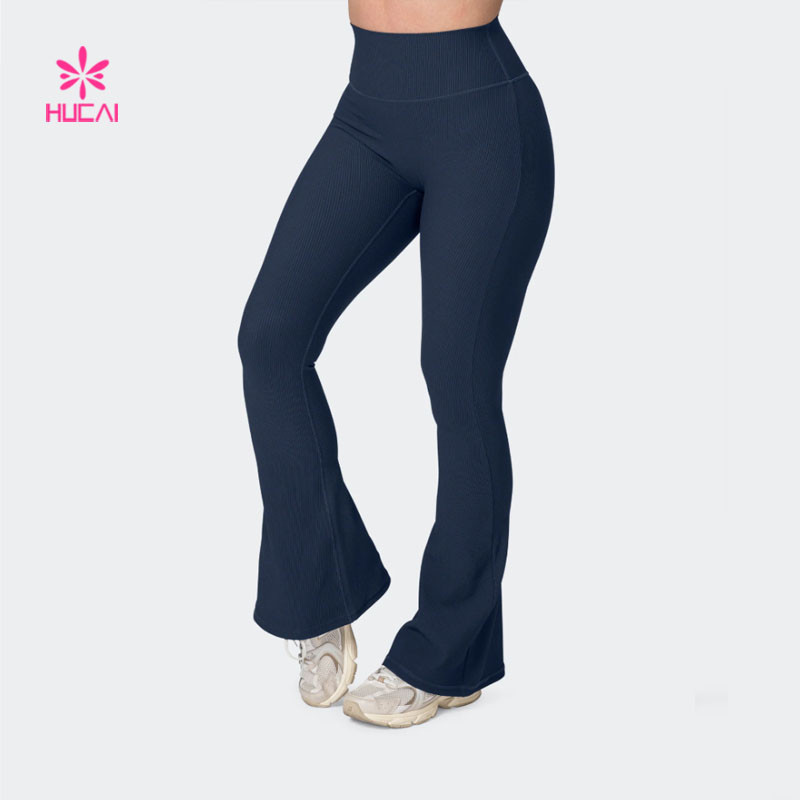
Interpretation. Hem width is the easiest number to copy and the least important one. If the flare starts above the knee, the calf looks wider and the leg shorter; if it starts below the knee, the leg reads longer. Without a fixed knee point per inseam, one pattern block produces a different silhouette in every size, so a size medium sample can photograph correctly while the size large ships as a different-looking garment.
Manufacturing recommendation. Specify the flare start as a measurable distance below the knee for each inseam length, and grade that value with the leg rather than freezing one hem width across the run. Judge the finished hem sweep on the body, in movement, at the largest size, because a flare that breaks once at the instep looks intentional while one that pools on the floor does not. HUCAI Sportswear fixes the knee point at the paper-pattern stage and confirms it again on the graded size set before bulk, which is the only stage where the correction is still inexpensive.
4. Hem sweep, inseam length and the drop question
Source and fact. Both references are sold as full-length styles and both are offered to a body-height range that spans roughly thirty centimeters. Splits59 presents its crossover flare inside a Raquel tights collection rather than as a single style, and DOYOUEVEN presents the Aura flare alongside the rest of its legging range. Length is being merchandised as an option, not as a footnote.
Observation. American and Canadian customers increasingly shop by length tier, and a flare makes that preference visible in a way a skinny legging does not. In a close-fitting leg, a two-centimetre inseam error shows up as a small break at the ankle. In a flared leg, the same error spreads across a wider opening and turns into several centimeters of hem sitting on or under the instep.
Interpretation. A hem that pools is not a cosmetic problem. It gets stepped on, it abrades, it wicks dirt up the inside of the leg, and it arrives back as a return with the complaint recorded against the fabric rather than against the length. The honest risk in a flare program is an inseam ladder that was never built, which leaves the brand choosing between one length that suits nobody and several lengths it has not sampled.
Manufacturing recommendation. Build the flare on a documented inseam ladder and run the walk test at both ends of the size range with the intended shoe height, since the same hem behaves differently over a flat trainer and a lifted one. Where a longer inseam is unavoidable, a soft silicone hem grip keeps the opening in place instead of relying on weight alone, and the inseam values accepted at sampling belong in the Tech Pack rather than in an email thread. Keeping the waist-to-knee block shared across lengths turns a new inseam into a price and schedule conversation, not a new fit round.
5. Holding one waist-to-hem proportion across a capsule
Source and fact. Neither reference treats the crossover flare as a standalone product. Splits59 sells its version inside a named tights collection, and DOYOUEVEN sells its flare inside a wider legging range with a shared fabric story. The style is the entry point to a set rather than the end of the range.
Observation. The crossover waist and the flare are converging into a recognizable signature block that brands extend downward and upward: shorts and capris below the legging, bras and layers above it. Customers who recognize the proportion once will pay for it again in a second length.
Interpretation. Extending the block is where a small brand's fit consistency usually breaks. Copying the hem width into a capri without rebuilding the knee point produces a bell rather than a flare, and copying the crossover apex into a shorter rise shifts the compression band off the waist line entirely. The pattern library, not the fabric, is doing the work here, and it is the asset most brands never think to fund.
Manufacturing recommendation. Keep one waistband block and one knee-point rule, then grade the capsule from that pair rather than redrawing each silhouette from a photograph. Approve color and handfeel on the complete set so a bra and a legging in the same launch are reviewed together, and finish the set with private label detail, including tagless heat-transfer labels, woven side labels, branded hangtags and biodegradable frosted polybags carrying your own logo. HUCAI Gymwear holds the full capsule on one development schedule, which keeps color, knit and fit approvals aligned instead of arriving three weeks apart.
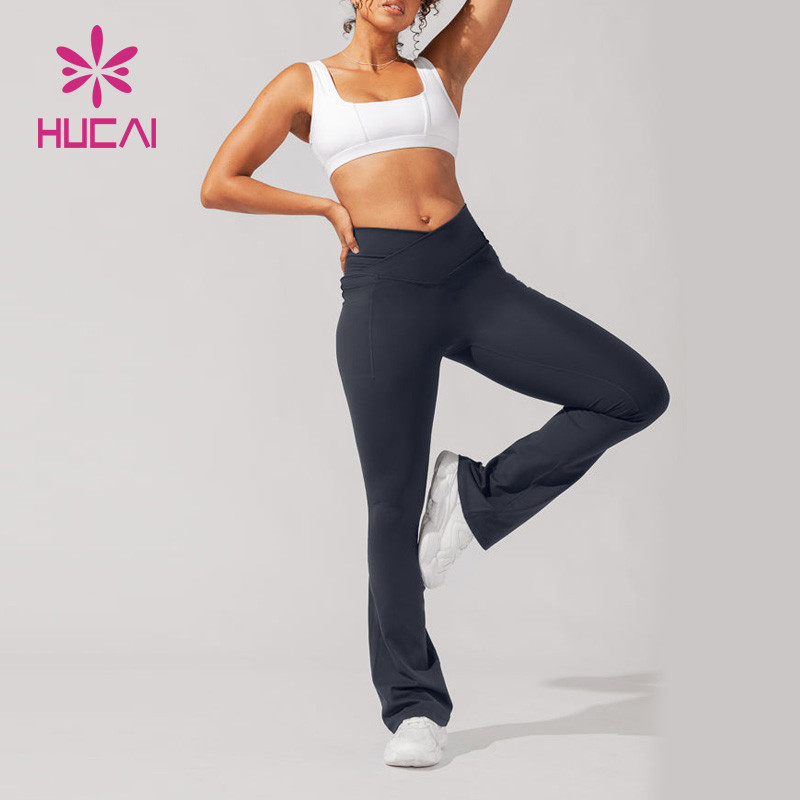
From Jean Yuan's product-development perspective, the mistake with flare leggings is treating the hem width as the design decision. The flare is only the visible end of a proportion chain that starts at the crossover apex and passes through the knee. In the Dongguan sample room the two crossing panels are paired and measured as a set, the knee point is fixed for each inseam before the first fit sample is cut, and the hem is judged on the body in movement, because an opening that pools on the floor comes back as a return no matter how well the waistband measures on a table.
Decision check: three construction routes for a flared legging
| Construction route | Waistband | Flare start | Suited to | Approval checks |
|---|---|---|---|---|
| Crossover waist with a knee-line flare | Two front panels crossing into a V, graded apex height | At the knee line, graded with each inseam | Studio, Pilates and athleisure sets | Crossing-point offset, band modulus, hem sweep on the body |
| Crossover waist with a scrunch flare | Crossover front with a gathered back panel | Below the knee, full length | Fashion-led gymwear and set merchandising | Back panel tension, opacity under stretch, hem break |
| Straight high-rise waist with a flare | Single high-rise band with an optional silicone hem grip | Below the knee, longer inseams | Everyday wear and tall length tiers | Band recovery, hem grip, inseam accuracy |
Planning a crossover flare or a full length tier for the coming season? Start with the block and the fit sample rather than a price list. The HUCAI Gymwear leggings range shows the waistband constructions currently running in production, and the crossover waist flared legging development is the shortest route to a first sample in your own fabric.
FAQ for American sourcing and product teams
Final takeaway
- Fix the crossover apex and the crossing-point offset as graded measurements, not as a styling note.
- Approve waistband recovery on the assembled garment, at the largest size and with the hem already attached.
- Set the flare start per inseam and judge the hem on the body in movement before bulk begins.
HUCAI Sportswear is a Dongguan-based women's gymwear manufacturer with in-house pattern development, 4-needle 6-thread flatlock stitching, AQL 2.5 inspection, flexible MOQ from 100 pcs per style and color, sampling at 7–10 working days and bulk production at 20–25 working days. To review the structures discussed here, start with the full length flared leggings development, the crossover waistband construction with 3D back panelling and the private label program.