Fabric-Family Merchandising: More Activewear SKUs From Fewer Fabrics
- Share
- publisher
- HUCAI
- Issue Time
- Oct 19,2026
Summary
How leading gymwear brands build collections from a few proven fabric platforms instead of a new fabric per style. This guide covers the knits that can carry bras, camis, leggings, capris and shorts, the four technical gates a base must clear, length and color continuity controls, testing standards, and how consolidation changes MOQ, sampling and reorders at 100 pieces per style and color.
Fabric-Family Merchandising: How to Build More Activewear SKUs From Fewer Proven Materials
Every emerging gymwear label eventually hits the same wall: the line sheet keeps growing while the fabric library grows faster. Six styles, five fabrics, four color stories, three different minimums — and suddenly a lean capsule has the inventory profile of a full department store. At HUCAI Gymwear, engineered by HUCAI Sportswear, we see this pattern in sample-room intake almost every month. The brands that scale cleanly are rarely the ones with the most materials. They are the ones that treat a single proven base as a platform and merchandise it across bras, camis, leggings, capris and shorts. This guide breaks down how the major players structure fabric families, what technical thresholds a base must clear before it can carry a whole collection, and how to build that structure at a 100-piece entry minimum.
Four reference points make the pattern visible. SET Active organizes its assortment around named fabric platforms — Luxform, Formcloud, Sculptflex and Sportbody — and its current Formcloud release extends a single base across bras, capris, control leggings, a Rally Tee, a training cami, control shorts and a shortysuit. Beyond Yoga sells Spacedye as a branded fabric family, carrying the same base into categories as different as a Caught In The Midi legging and a Forever Bra in the same Nocturnal Navy colorway. lululemon's Nulu Align shop currently lists 34 styles under one fabric filter, spread across bottoms, leggings, tops, tank tops, shorts, joggers, dresses, skirts and bodysuits, and describes Nulu as buttery soft and weightless. Kith Women's Proper Form line uses just two signature fabrications, Studio and Enhance, and splits them by impact level rather than by print or seasonal novelty.
Fabric-family merchandising means committing to two or three proven bases and extending each one across silhouettes instead of sourcing a new fabric per style. A base qualifies when it holds opacity under squat tension, recovers after stretch, and dyes consistently across tops and bottoms. Consolidation cuts sampling cycles, color-matching risk and minimum quantity exposure.
- 1. What a Fabric Family Actually Is — and What It Is Not
- 2. The Four Numbers That Decide Whether One Base Can Carry Ten SKUs
- 3. Building the SKU Ladder From Bra to Legging
- 4. Length Extensions: Capri, 7/8 and 6-Inch Shorts
- 5. Tops and Camis: The Lowest-Cost Way to Widen a Family
- 6. Color Continuity Across a Family
- 7. What Consolidation Does to MOQ, Sampling and Reorders
- 8. Testing Gates Before You Commit a Base
- 9. Questions US and Canadian Buyers Ask Most
1. What a Fabric Family Actually Is — and What It Is Not
A fabric family is a single base construction — one knit structure, one fiber blend, one finishing route — that is engineered once and then reused across multiple silhouettes. It is not a color story, and it is not a print. Those are surface decisions applied on top of a base. The distinction matters because the cost of a base lives in the fabric development stage: yarn sourcing, knitting gauge, dyeing recipe, shrinkage control and handfeel tuning. Once that work is banked, every additional silhouette cut from the same base inherits the validated data instead of restarting the process.
The reference brands show two ways to organize the same idea. SET Active names its bases and lets each name carry a mood, so a shopper learns what Formcloud feels like and returns to it across categories. Kith Women takes the functional route: Studio and Enhance are separated by support level, with the lighter base positioned for lower-impact training and the firmer base reserved for sessions that need more hold. Both approaches reduce the number of variables a buyer has to evaluate, and both make reordering predictable because the fabric itself never changes mid-season.
What a family is not: a pile of similar-looking fabrics sourced from different mills. Two jerseys that both feel soft can behave completely differently after ten wash cycles, and when they sit in the same matching set the difference becomes a customer complaint rather than a sourcing detail.
2. The Four Numbers That Decide Whether One Base Can Carry Ten SKUs
Not every fabric deserves to become a platform. Before a base is allowed to spawn a bra, a cami, a legging, a capri and a short, our pattern and production teams ask four questions that have measurable answers. If a base fails any one of them, the family stops at one or two silhouettes.
Weight and density
Weight sets the ceiling on how far a base can travel. A light, airy knit reads well on a cami or a light-support bra but turns translucent the moment it is stretched over a glute seam. A denser interlock holds shape on leggings but feels heavy against the skin in a tank. In practice, most successful families sit in a mid-weight band and lean on knit density — not thickness — to deliver opacity. Density is what blocks light; thickness only adds warmth.
Modulus and stretch direction
Stretch percentage alone tells you very little. What matters is how much force the fabric needs to reach a given extension, and whether that force is the same along the length and across the width. A base that stretches easily in one direction and firmly in the other will distort a waistband on leggings while feeling fine on a bra. When a family spans both tops and bottoms, the base has to be balanced enough that a patternmaker can compensate with blocking rather than with a new fabric.
Recovery after extension
Recovery is the number buyers feel but rarely specify. A base that returns to its original dimensions after being stretched over a hip or a thigh keeps its shape through a training cycle; one that creeps stays stretched at the knee and the waistband. Recovery is also what allows a bra and a legging to share a base at all, because the bra needs a firmer return at the underband while the legging needs a softer return at the waist.
Opacity under tension
The final gate is the one that decides whether a family is viable for bottoms at all. Opacity has to be evaluated on a stretched sample under directional light, not on a flat swatch on a table. A base that passes on the table and fails at 40 percent extension cannot carry leggings, no matter how good the handfeel is.
3. Building the SKU Ladder From Bra to Legging
Once a base clears the four gates, the ladder is straightforward to plan. The sequence that works most reliably starts with the highest-risk silhouette, not the easiest one. Develop the legging first, because it puts the base under the most tension and exposes opacity and recovery limits earliest. If the base survives a full-length legging in the lightest color of the range, the bra, cami, capri and short that follow are lower-risk derivatives.
The second rung is the bra, and the engineering work there is mostly about support structure rather than fabric. The same base can be used for a light-support bra with a clean underband and for a medium-support style with a double front panel, as long as the pattern team adjusts panel counts and strap attachment instead of reaching for a firmer fabric. This is where a family either holds together or quietly splits into two fabric stories.
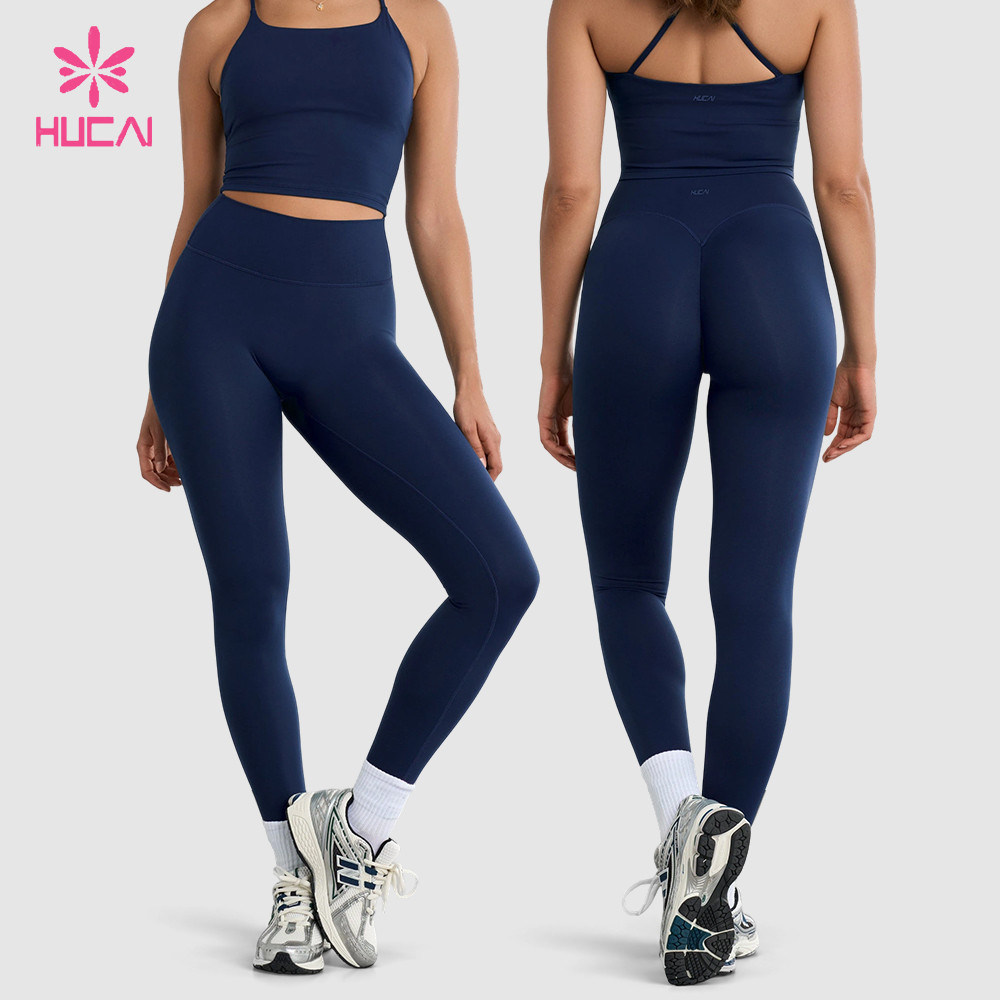
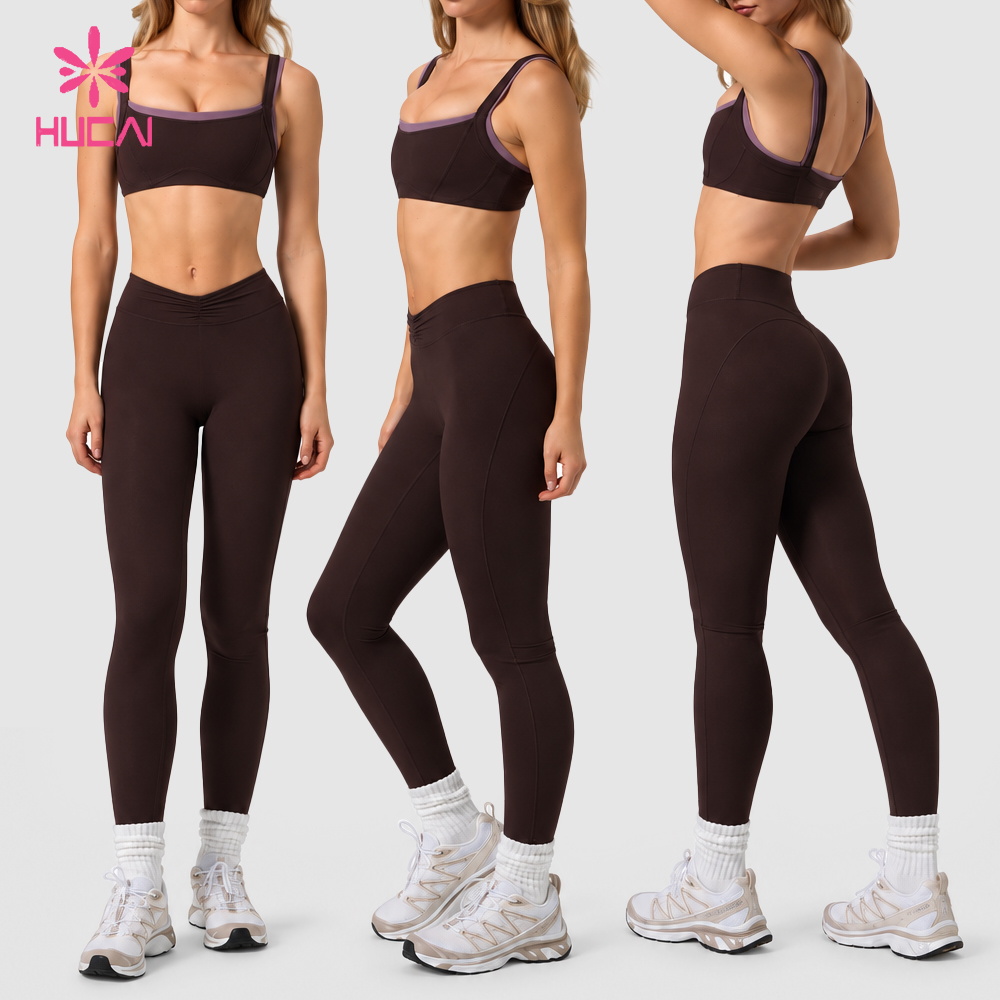
The third rung is the matching set, which is the commercial reason most brands attempt consolidation in the first place. A set only works if the top and bottom read as one garment in the same light. That is a dyeing and finishing discipline more than a design one, and it is why we recommend developing the set as a single unit with one color approval rather than approving each piece separately. A set built this way — for example a ruched-waist legging paired with a wide-strap bra in the same base — carries a single fabric order, a single dye lot and a single test report.
You can review a production example of this structure in our ruched-waist legging and wide-strap bra set developed for US brands, where both pieces are cut from one base and finished as a coordinated unit.
4. Length Extensions: Capri, 7/8 and 6-Inch Shorts
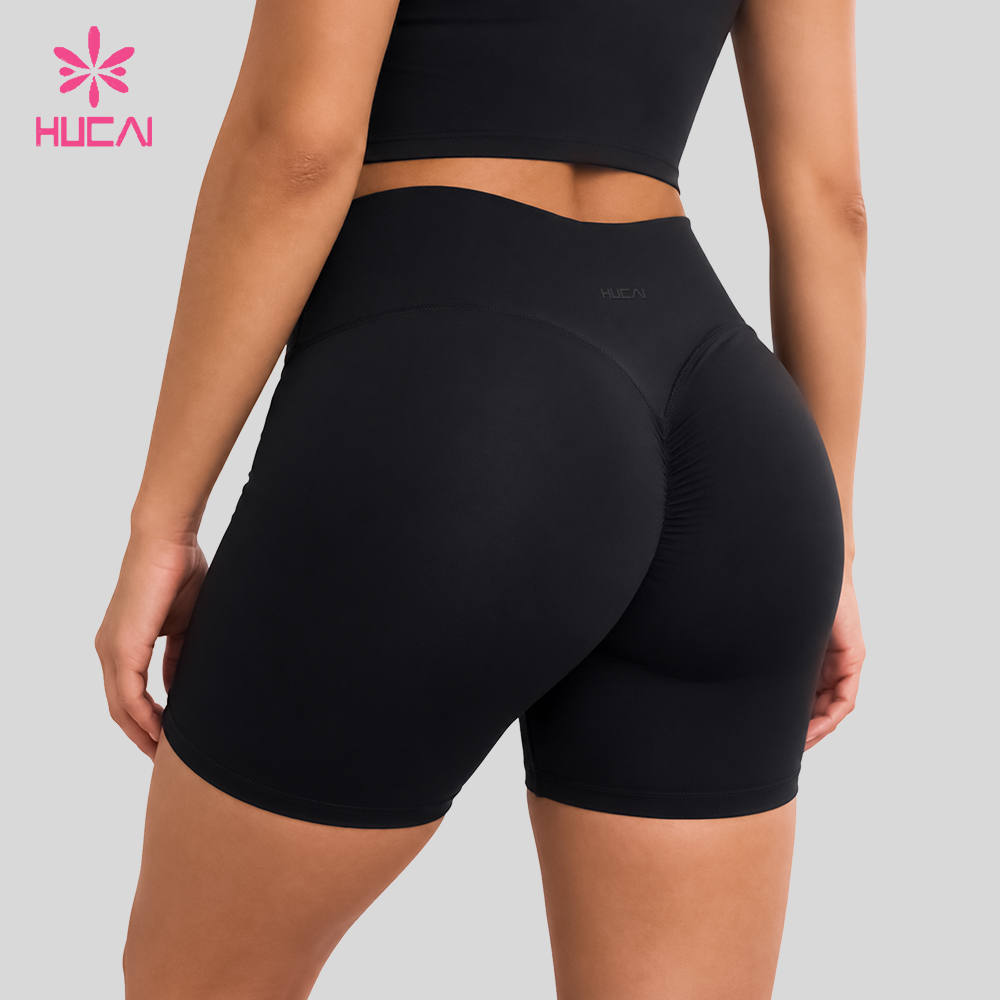
Length variations are the least expensive way to widen a family and the easiest place to get the engineering wrong. The instinct is to take a full-length block and cut it shorter. That approach fails because hem circumference, knee placement and panel proportion all change with length. On a 6-inch biker short, the hem lands on the mid-thigh, which is the widest part of the leg under load — the hem has to grip without digging, or it will roll upward through a set of lunges. On a capri or 7/8, the hem sits below the calf, where the leg changes shape fastest during movement.
The practical answer is to plan lengths in the pattern stage as a family of graded blocks rather than a family of trims. Each length gets its own hem tension specification and its own relationship to the waistband, while the body panels continue to share the base. That keeps the fabric order consolidated without asking a single block to do two jobs. It also keeps the fit conversation honest: a buyer comparing a 6-inch short and a 25-inch legging should be evaluating two engineered garments, not one garment and one truncation.
For brands testing a family for the first time, two lengths are enough to learn from — one full-length legging and one 6-inch short. The pair covers studio and training use, validates hem engineering at both extremes, and leaves the capri and 7/8 as second-season additions once sell-through data exists. Our full-length scrunch legging program is often the block we start from before grading additional lengths.
5. Tops and Camis: The Lowest-Cost Way to Widen a Family
If bottoms are where a base is proven, tops are where a family becomes a collection. A cami or a tank uses less fabric per unit, sits under lower tension, and can be graded from the bra block with relatively small pattern changes. It is also the piece that turns two matching sets into a four-piece wardrobe story, which is exactly the merchandising logic visible in the reference brands: a fabric name earns a dedicated page only when it has enough silhouettes to fill one.
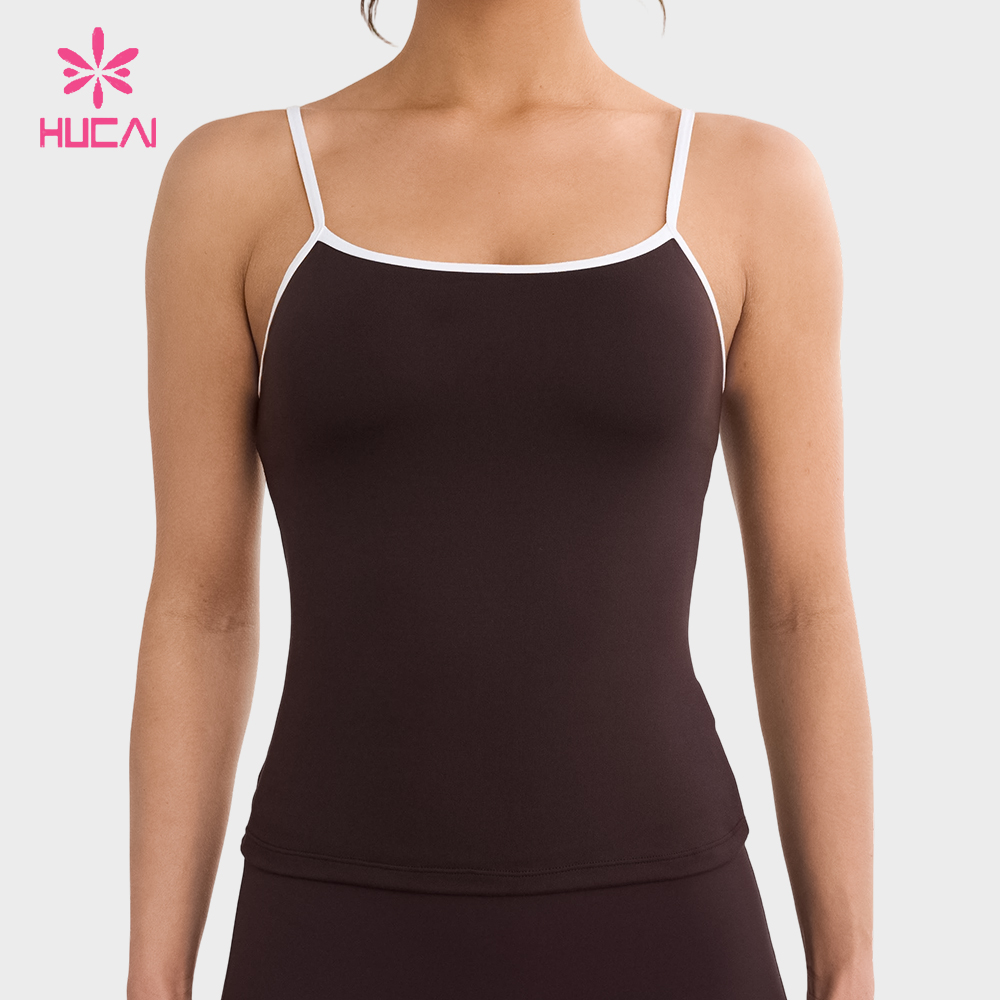
The construction decisions that matter most on tops are binding, strap attachment and the inside finish. Contrast binding is the lowest-risk way to make a top read as a separate design while keeping the body fabric identical — the trim changes, the base does not. A built-in bra shelf or an inner lining is a second, slightly higher-risk variation, because the lining is usually a different quality and has to be color-matched to the outer shell.
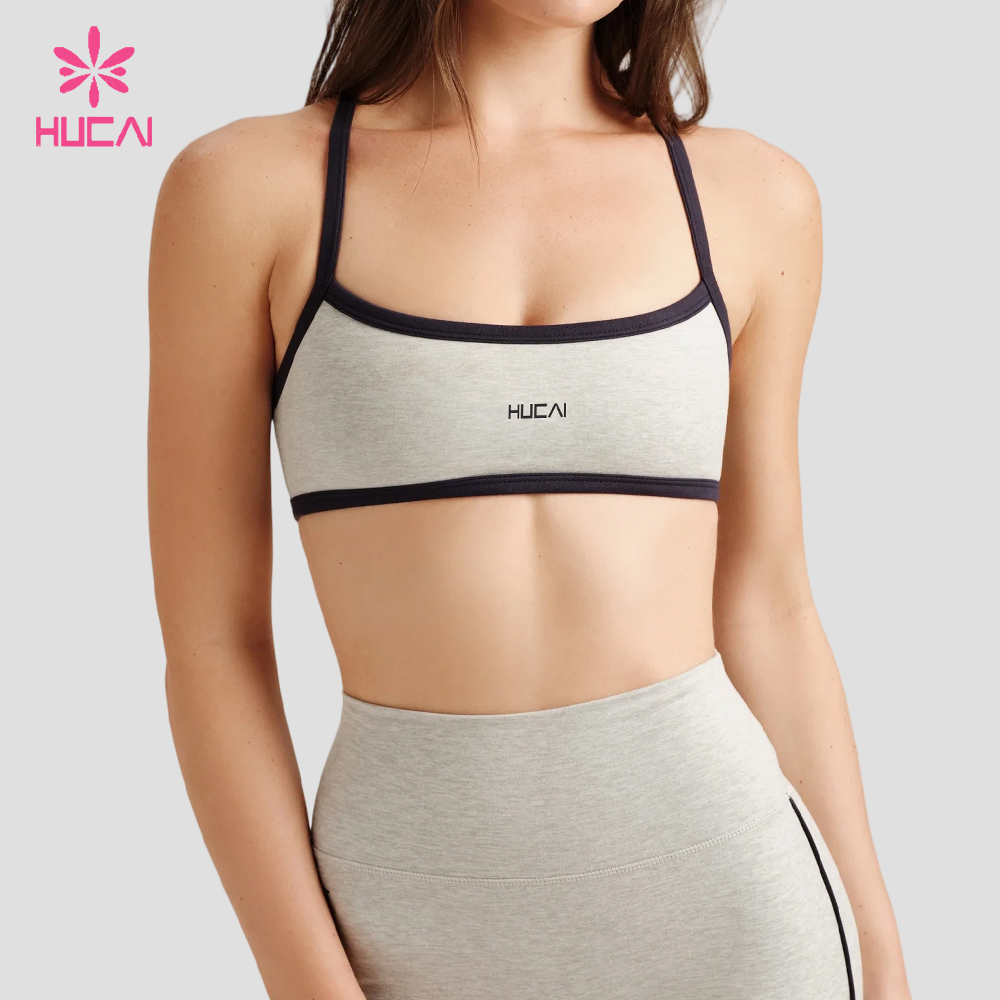
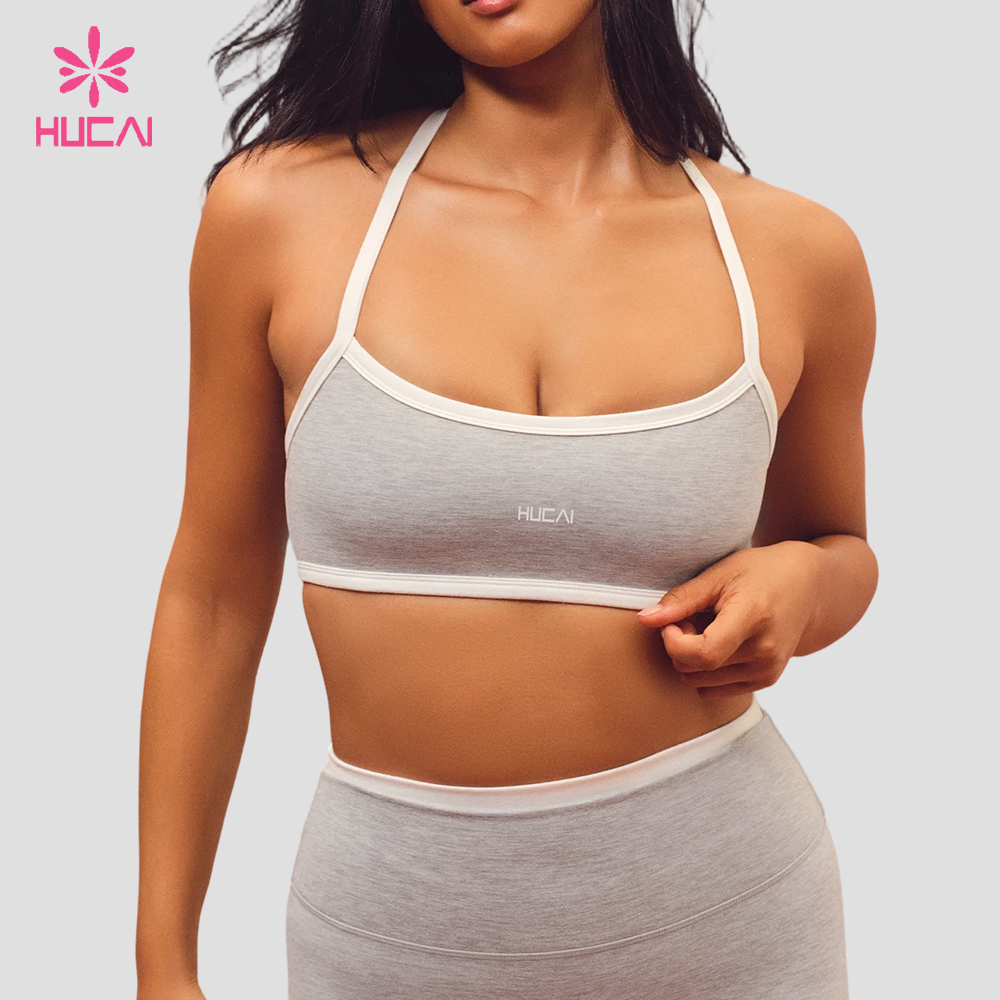
A cami with built-in support and contrast trim is a good example of how far one base can travel without a new fabric development cycle; you can see the construction in our spaghetti-strap camisole with built-in bra. The same base also supports a scoop-neck bra with contrast binding, which is the natural bridge between the cami and the legging in a four-piece capsule.
6. Color Continuity Across a Family
Consolidation removes one class of risk and concentrates another. When every style had its own fabric, a shade difference between a top and a bottom could be explained away as a design choice. Once a family is sold as a set, any visible difference becomes a defect. The failure mode is not dramatic: two pieces in the same nominal color that differ by a fraction of a shade read as mismatched under retail lighting, and the customer returns the pair rather than choosing one piece.
The controls that prevent this are procedural. Approve color once, against one physical standard, for the whole family rather than per style. Keep tops and bottoms on the same dye lot whenever the set is sold together, and treat any lot change as a re-approval event. Where a family spans a knit and a woven or a heavier trim, expect the trim to absorb dye differently and plan for that in the standard rather than after the fact. This is where beyond-the-surface experience matters: heather and melange bases are the hardest to match across panels, because the visual shade is a product of fiber blending, not just dye concentration.
Trims deserve their own line in the color plan. Binding, elastic, drawcord and thread are often sourced separately from the base, and a trim that is close but not matched is more noticeable than a slightly different body shade. Specifying trims as a matched set at the same approval gate keeps the family coherent when the styles are merchandised together.
7. What Consolidation Does to MOQ, Sampling and Reorders
The commercial argument for fabric families is not aesthetic, it is arithmetic. Fabric minimums are usually expressed per quality per color, and a startup line with five bases and four colors is effectively committing to twenty fabric positions before a single garment is cut. Consolidating to two bases and four colors cuts that to eight positions, which is the difference between a line that can be funded from a first production budget and one that needs inventory financing.
Sampling behaves the same way. A new base requires a development round — knitting, dyeing, handfeel approval, shrinkage and opacity testing — before a single fit sample can be cut. Reusing a proven base removes that round from every subsequent style, so a five-style capsule built on two bases can move through sampling in the time a two-style capsule would normally take on new fabrics. At HUCAI Sportswear, samples typically run 7 to 10 working days when the base is already in development, and bulk production runs 20 to 25 working days from pre-production sample approval and deposit.
Reorders are where the structure pays back. With a consolidated family, a reorder on the bra pulls the same base and the same color approval as the legging, which shortens the confirmation cycle and reduces the risk of a lot mismatch appearing in a restock. With fragmented fabrics, every reorder reopens the color question.
8. Testing Gates Before You Commit a Base
A base should not be promoted to platform status on handfeel alone. Before a fabric is allowed to carry a full family, we run it through a fixed set of gates and record the results against the quality, so that every style cut from it inherits the same evidence. Opacity is tested on stretched samples under directional light rather than flat on a table, and bottoms are held to a Grade 4-5 squat-proof standard before approval. Recovery is checked after repeated extension cycles, with the waistband and the hem treated as separate test points because they fail differently.
Construction is tested alongside the fabric. A base that performs well in the flat may still fail at the seam, so the stitch specification is validated at the same time — most of our stretch families are built with 4-needle 6-thread flatlock seaming to keep the seam flat and elastic under load. Pilling and surface change are checked after wash cycles, since a base that looks new at sampling and fuzzes after five washes will damage the whole family's reputation, not just one style.
At HUCAI Sportswear, final inspection follows AQL 2.5, with key dimensions and seam integrity checked across the shipment. The point of documenting these gates is not compliance for its own sake: it is that a consolidated family concentrates risk, so the evidence has to be strong enough to cover every silhouette derived from it.
From Jean Yuan's product-development perspective, the first season should not be judged by how many fabrics a brand can source, but by whether one fabric can honestly support several selling styles. In the Dongguan sample room, the recurring failure is a base that looks convincing on a bra and collapses on a legging in the lightest color, because nobody tested the same quality under full-length tension. Her view is that fabric consolidation only works when the pattern team is allowed to change panels, hem tension and waistband structure within the same base — otherwise the brand ends up with one fabric name and five unrelated fits.
Decision Check: Two-Base Family vs. Five-Base Line
| Line Structure | Fabric Positions at 4 Colors | Development Rounds | Color-Match Exposure | Typical Use For |
|---|---|---|---|---|
| Two-base family brushed interlock + rib |
8 | 2 bases validated once, reused across 6–8 styles | Low — one approval per color per base | First and second season capsules, studio and set-led ranges |
| Three-base family interlock + rib + compression |
12 | 3 bases, one round each, then reused | Moderate — three standards to hold in parallel | Brands spanning studio, training and sculpt categories |
| Five-base line one fabric per style |
20 | 5 separate rounds, no reuse | High — every set is a new match risk | Established labels with dedicated fabric development capacity |
Fabric positions assume four colors per base and a 100-piece minimum per style and color. Development rounds refer to base validation, not fit sampling, which is required for every silhouette regardless of structure.
Planning a Family Instead of a Single Drop?
Request the current knit and rib swatch set, with handfeel, density and recovery notes, so the base decision can be made before patterns are cut.
Review the New Arrivals Range →Questions US and Canadian Buyers Ask Most
Three Decisions to Lock Before the Next Drop
First, choose the base before the silhouettes: validate opacity, recovery and stretch balance on the legging block, because it is the silhouette that will expose every weakness. Second, plan lengths and tops as graded derivatives of that block so the fabric order stays consolidated while the fits stay independent. Third, approve color once per family and hold trims to the same standard, since a set that is one shade apart will return regardless of how well it fits.
At HUCAI Gymwear, this is the sequence we run with emerging US, Australian and Canadian labels: two or three proven bases, a ladder of silhouettes cut from each, and one documented test record per base that every style inherits. It is a less glamorous way to build a line than sourcing a new fabric for every style, and it is the reason consolidated ranges survive their second and third season.