Ribbed Performance Sets: Texture, Compression and Recovery in Premium Activewear
- Share
- Issue Time
- Oct 12,2026
Summary
Ribbed knits have grown from a single seamless base layer into a full fabric family, and US, Canadian and Australian labels are now building whole sets on one ribbed surface. This guide covers the grounded brand evidence behind that shift, then the manufacturing limits that decide whether a ribbed bra and legging hold their shape: rib gauge and direction under lateral stretch, waistband roll-over, shade and batch consistency, and the recovery and wash checkpoints used before bulk.
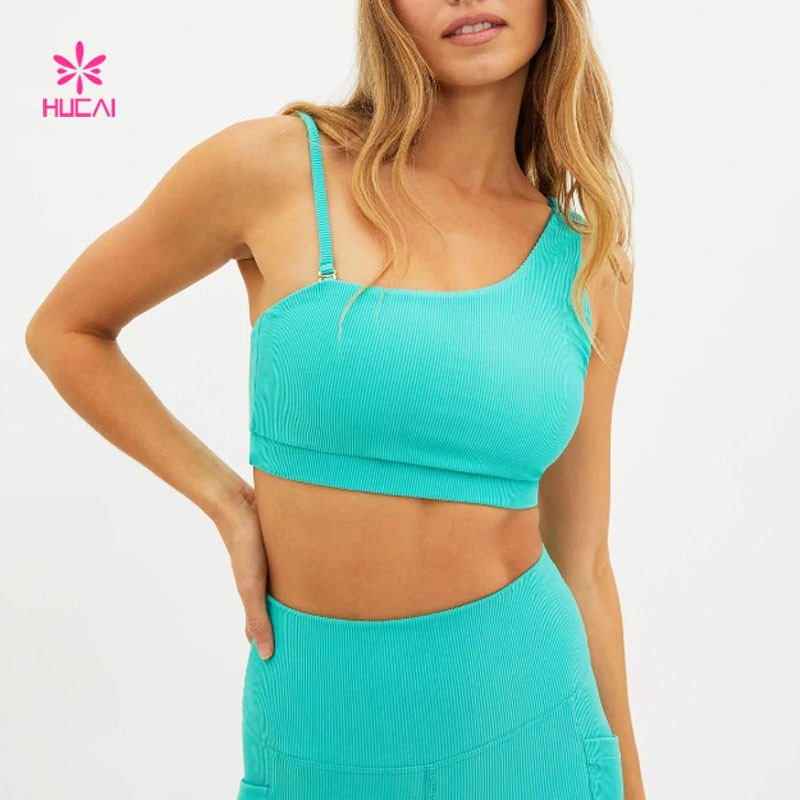
Ribbed Performance Sets: Texture, Compression and Recovery in Premium Activewear
Ribbed knits have moved from a single seamless base layer to a full fabric family. At HUCAI Gymwear, engineered by HUCAI Sportswear, we develop ribbed bras, leggings and matching sets for US, Canadian and Australian labels, and the questions that reach our development room are rarely about which rib looks newest. They are about rib gauge, stretch direction, recovery after washing, and whether a set still reads as one color once it is pulled on. This guide works through the market facts behind the ribbed revival, the manufacturing limits that decide whether a ribbed style keeps its shape, and the specification checkpoints HUCAI applies before a bulk run leaves Dongguan.
Source A. Carbon38's Ribbed Melt high-rise legging is documented on the brand's official product page as 77% Polyester / 23% Spandex, described by the brand with a buttery-soft, sculpting ribbed texture, four-way stretch, moisture-wicking performance and a secure high-rise waistband; the same Melt Rib family extends into a matching racerback bra and ribbed tanks. Source B. Year of Ours currently presents a Ribbed Layered Bralette, a Ribbed Layered Legging and a Ribbed Two Tone Veronica Legging on its official newest-arrivals page, and the Active Rib Sets page groups a bra, a legging, a long sleeve and a ribbed shrug into one texture family. Observation. Neither reference is selling a single ribbed style. Both build a set around one ribbed surface, which makes the rib itself the product platform rather than a finish applied to one SKU.
A ribbed set holds its shape when rib gauge, rib direction and recovery are specified together, then confirmed after a wash cycle rather than only on a flat sample. The rib line should stay even across the hip on every size, and where a ribbed waistband meets a flatter body panel, that density change is the point most likely to roll. HUCAI Gymwear develops ribbed sets from a flexible MOQ of 100 pcs per style and color, with 7–10 day sampling.
- 1. From Base Layer to Fabric Family: Why Ribbed Became a Set Strategy
- 2. Rib Gauge and Direction: What Actually Happens Under Stretch
- 3. Waistband Engineering Where Rib Density Changes
- 4. Shade, Surface and Batch Consistency Across a Set
- 5. QC Checkpoints for Ribbed Sets: Symmetry, Recovery and Wash Stability
- 6. Sourcing Questions from US, Canadian and Australian Teams
1. From Base Layer to Fabric Family: Why Ribbed Became a Set Strategy
Source and fact. Carbon38 positions its Ribbed Melt legging as a core fabric with a defined fiber content, and Year of Ours extends one Active Rib surface across a bralette, a legging, a long sleeve and a shrug. In both cases the ribbed material is the organizing idea, and the individual styles are variations on it.
Observation. For a young label this is a merchandising signal rather than a styling note. A recognizable rib surface lets a brand photograph one texture across a whole drop, and it gives a repeat customer a reason to buy the second piece. Ribbing also survives the compression conversation that flat knits struggle with: a ribbed bra can read as sculpted without being as tight as a high-compression flat knit.
Interpretation. The risk sits in treating a ribbed set as one fabric bought once. A rib is a knit structure, not a color, so two mills can deliver the same fiber content and the same Pantone reference and still produce a visibly different rib height, a different width-to-length stretch ratio and a different surface sheen. When the bra and the legging are cut from different production lots, the set that looked unified in the lookbook can read as two garments on the shelf.
Manufacturing recommendation. Treat the ribbed surface as a platform and lock it as a spec: rib height, courses per centimeter, weight per square meter, width and length stretch, and recovery after a defined wash cycle. Then buy the bra and the bottom from the same lot wherever the order volume allows, and confirm the set side by side rather than as two separate samples. Brands building a first ribbed capsule can review how we structure that development on the ribbed sports bra and yoga pants set development page before the fabric is committed.
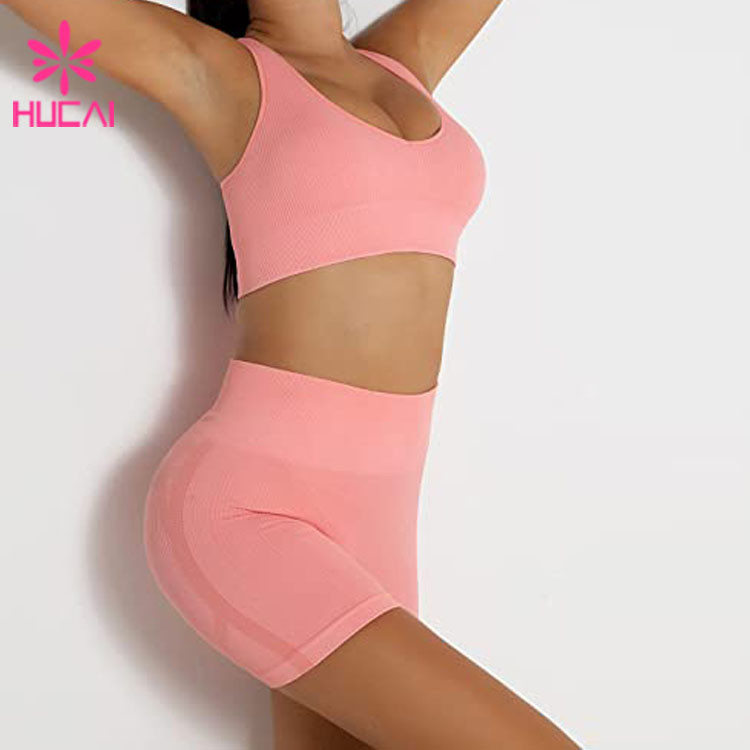
2. Rib Gauge and Direction: What Actually Happens Under Stretch
Source and fact. The reference legging in Source A is specified at 77% Polyester / 23% Spandex, and the brand describes four-way stretch and a sculpting ribbed texture as one combined benefit. On our own leggings and ribbed knit programs we work in the 73% polyester / 27% spandex, 73% nylon / 27% spandex and 75% nylon / 25% spandex range at a typical 220–260 GSM, which is the band where a rib holds recovery without turning rigid.
Observation. Consumers describe ribbed fabric by how it feels in the hand, then judge it by how it still looks at the end of a session. A deeper, coarser rib reads as more premium on a hanger, and a finer rib reads as more technical. Both are commercially valid, but they behave differently the moment the garment is pulled laterally across the hip or the thigh.
Interpretation. Rib recovers in the direction it was knitted, so a rib that runs vertically down the leg widens and flattens when the legging is stretched around the body, and the surface appears lighter at the same moment. That is the real reason a ribbed set can look narrower in a flat sample than on a moving wearer. A second issue is directional mismatch: if the waistband is cut with its rib running across the body while the leg panel runs vertically, the two zones relax at different rates and the transition between them becomes visible.
Manufacturing recommendation. Specify rib gauge and rib direction together, and record the maximum stretch direction on the tech pack rather than leaving it to the cutter. HUCAI Sportswear measures rib width and rib height before and after a controlled stretch, then compares the numbers across the full size range instead of only on the middle size, because the largest grade stretches the furthest and exposes a lightening surface first. The ribbed and seamless knit routes we use for this are listed on the seamless sportswear category page, which shows the same zoning logic applied to knitted rib panels.
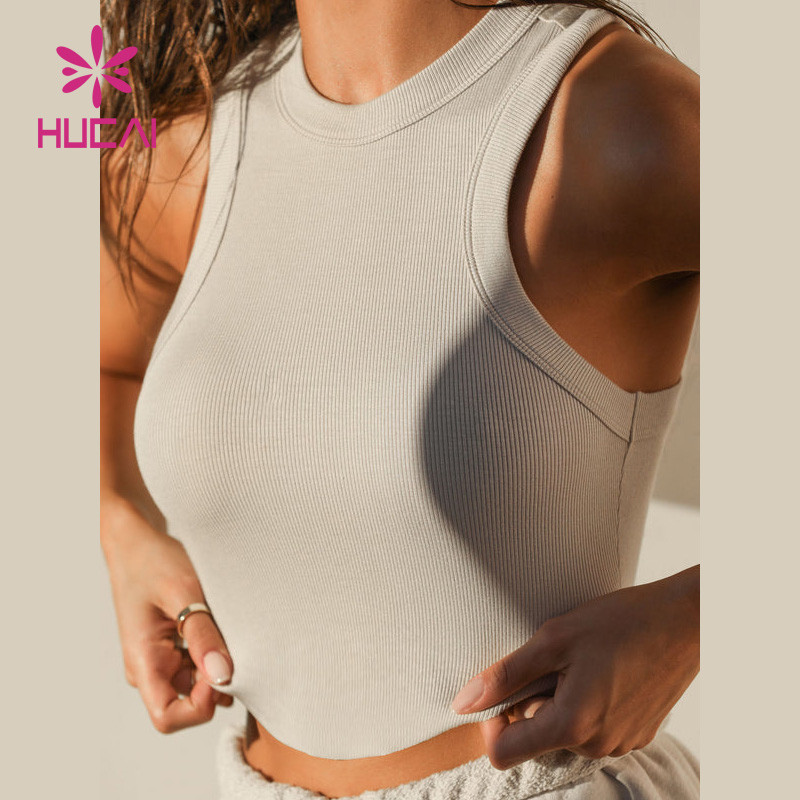
3. Waistband Engineering Where Rib Density Changes
Source and fact. Source A highlights a secure high-rise waistband as a stated feature of the reference ribbed legging, and Source B carries the same ribbed surface from the legging into a layered bralette and a long sleeve. The waistband is the one zone that must hold position on both a ribbed bottom and a ribbed top.
Observation. Roll-over and ride-down are the complaints that decide repeat purchase on a studio set. A ribbed waistband photographs well because the texture reads as structure, but it also gives the band more room to relax away from the body than a flat interlock waistband at the same elastane percentage.
Interpretation. The failure is almost always at the density transition, not in the band as a whole. Where a ribbed band is joined to a flatter leg panel, or to a ribbed body at a different rib height, the seam line carries a step change in stretch. Under a loaded squat or a deep lunge, the looser side gives first, the firmer side holds, and the band starts to fold. Because the fold follows the seam rather than the waistline, it can also appear as an asymmetric pull on one hip.
Manufacturing recommendation. Engineer the waistband as one continuous zone with its own specification. In our sample room we set the band rib height and the body rib height as separate values, keep the recovery targets of the two close enough that the seam does not become a hinge, and assemble the stretch joint with a four-needle six-thread flatlock so the transition stays flat against the body. Every ribbed bottom is then worn through a squat, a lunge and an overhead reach on a live fit model before the pattern is released. The leggings construction library on the custom leggings category page shows how these bands are typically built across our ribbed and flat knit programs.
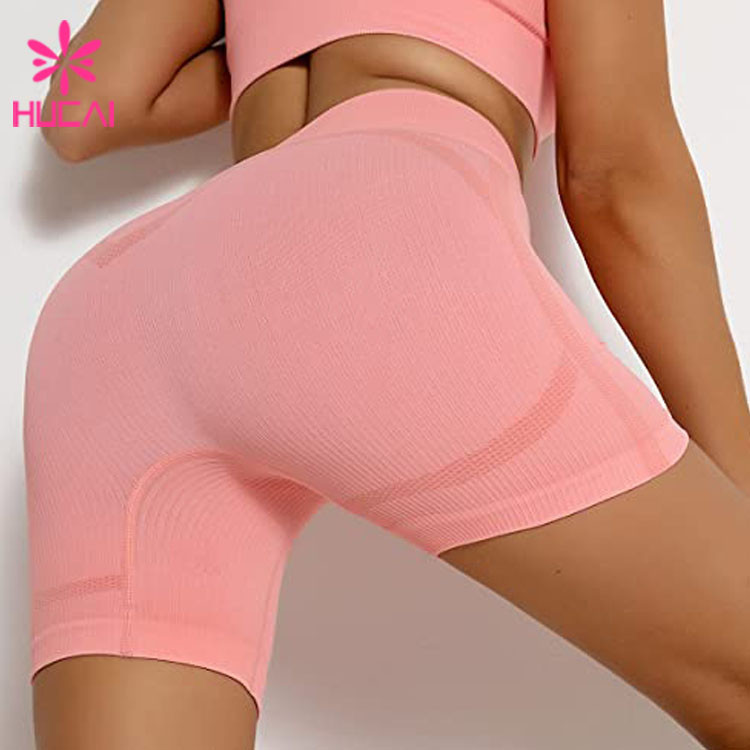
4. Shade, Surface and Batch Consistency Across a Set
Source and fact. Source A pairs a documented fiber content with a named surface family that runs from the legging into the bra and the tank, and Source B presents a Ribbed Two Tone legging alongside single-tone ribbed pieces. Both approaches depend on the ribbed surface rendering the same color consistently from piece to piece.
Observation. Rib is a three-dimensional surface, so it reflects light differently depending on the viewing angle, the rib height and how far the fabric is stretched. Buyers comparing a bra and a legging on a table see one tone; the same two pieces on a moving wearer, at a different stretch on each, can read as two depths of the same color.
Interpretation. This is why ribbed programs are more sensitive to batch variation than flat knits. Rib height, courses per centimeter and relaxed weight drift between production runs in ways that show up as a slight shade and sheen difference, not as a visible defect. On a dark plum, berry or espresso set the drift is amplified, because a small change in surface relief changes how much light the crest of each rib returns.
Manufacturing recommendation. Approve the set as a set, under stretch, and approve the batch as a batch. We ask brands to sign off the bra and the bottom side by side on a live model rather than as flat swatches, and we hold the rib height and the relaxed weight inside a defined tolerance band from run to run. Pantone TPX and TCX custom dyeing is handled by fabric base, so a ribbed surface and any flatter trim used in the same set are matched as separate substrates rather than assumed to take color identically. When a drop is built around a set, the studio tops that usually complete it are on the sports tank top category page.
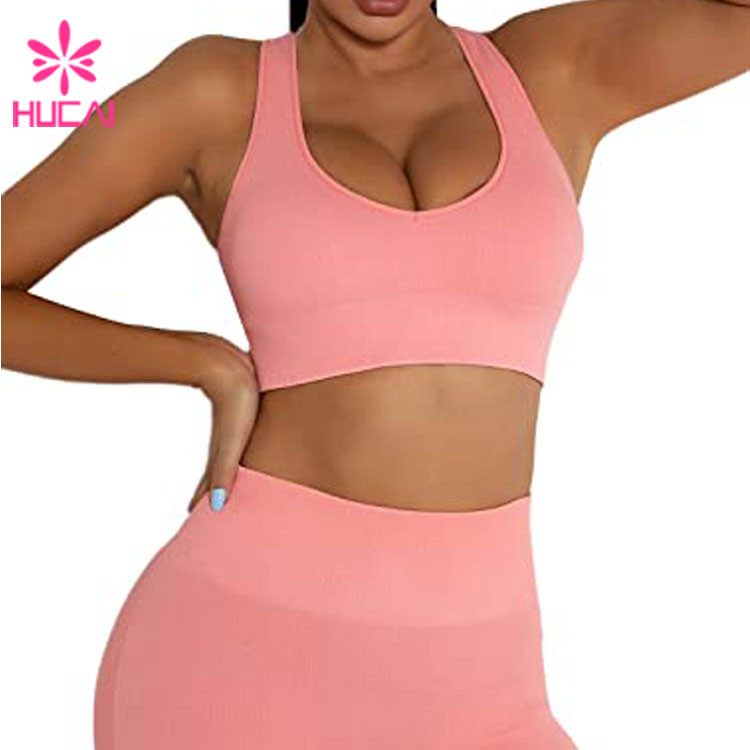
5. QC Checkpoints for Ribbed Sets: Symmetry, Recovery and Wash Stability
Source and fact. Both reference families present their ribbed pieces as complete outfits rather than as isolated styles, and the ribbed surface is the element that visually ties the bralette, the legging, the long sleeve and the shrug together. That makes rib behavior a quality attribute of the set, not only of the fabric roll.
Observation. Standard inspection catches a broken stitch or an uneven hem, but it will not catch a rib that has relaxed unevenly across one hip, or a waistband that has grown half a size after the first wash. Those are the faults a customer notices on the second wear, which is exactly when a small brand has least room to absorb a return.
Interpretation. A ribbed garment therefore needs a measurement set that goes beyond the standard size chart. Rib symmetry left to right, rib height at the waistband against the body, and the change in both after a wash and dry cycle are the numbers that predict whether the garment survives repeat wear. A rib line that reads even on a table can widen unevenly across the hip on a curvier grade, and a waistband cut with a different rib direction from the body will begin to roll as soon as the rib relaxes.
Manufacturing recommendation. Add rib-specific checkpoints to the inspection plan. HUCAI records rib symmetry and rib height on the flat and on the worn garment, re-measures both after a wash and dry cycle, and carries the same checks into final inspection alongside AQL 2.5, with bottoms verified against a Grade 4–5 squat-proof opacity standard. For a first drop, the seasonal palette and ribbed developments we are currently sampling are listed on the new arrivals collection page.
Decision Check: Comparing Ribbed Surface Routes
| Rib Surface Route | How the Texture Is Created | Stretch and Recovery Behavior | Main Risk to Control | Sample Checkpoint |
|---|---|---|---|---|
| Fine-gauge flat interlock | Smooth knitted surface with no visible rib | Lower width stretch, stable recovery | Opacity at maximum stretch | Grade 4–5 squat-proof and opacity testing |
| Narrow vertical rib | Fine rib lines formed in the knit structure | Moderate width stretch, good memory | Rib widening visibly after stretch | Measure rib width before and after controlled stretch |
| Pronounced wider rib | Coarser rib with deeper surface relief | Higher width stretch, softer hand | Relaxation and recovery loss after washing | Wash-and-dry dimensional check against the approved weight |
| Mixed rib band and flat body | Engineered zoning between two knit densities | Local stretch difference at the transition | Waistband roll-over and asymmetric pull | Symmetry and roll-over check on a live fit model |
Two ribbed sets can look identical on a flat sample and behave differently after five washes, because the rib height, the rib direction and the recovery target were never written down together. If your brief is moving toward a ribbed capsule for a studio collection, it is worth settling the rib specification, the waistband zone and the wash standard before the pace of the drop makes a change expensive. You can share a reference set photo or a draft tech pack with our development team for a construction review before the fabric is committed.
From Jean Yuan's product-development perspective, a ribbed set has to pass two different tests, and most suppliers only run the first one. A rib that looks even on the sample table can widen unevenly across the hip on a curvier grade, and a waistband cut with a rib direction that does not match the body will start to roll as soon as the rib relaxes under load. In our Dongguan sample room we check rib symmetry left to right on the worn garment, then re-measure rib height and waistband height after a wash and dry cycle. A ribbed set that only passes the flat check is not ready for bulk production.
6. Sourcing Questions from US, Canadian and Australian Teams
Final Takeaway
Three decisions decide whether a ribbed set performs commercially. First, treat the rib as a platform and specify rib height, rib direction, weight and recovery together, then buy the bra and the bottom from the same lot wherever volume allows. Second, engineer the waistband as its own zone, because the density change between a ribbed band and the body is where roll-over starts. Third, add rib-specific checkpoints to inspection, since rib symmetry and post-wash recovery are the faults a customer discovers on the second wear rather than on delivery.
HUCAI Gymwear develops custom ribbed bras, leggings, sets and studio tops for brands in the United States, Canada and Australia, from first sample through to bulk delivery, with private label packaging, fabric color matching and inspection handled in one production flow.